Scale AI vs Appen vs Lionbridge: Which AI Data Labeling Platform Pays Best in India 2026
If you’re scrolling through Reddit or browsing freelancing forums, you’ve probably seen Indian freelancers debating which best AI data labeling platform India 2026 offers the highest income. The truth? It depends on more than just hourly rates. Scale AI might promise ₹500–₹800 per hour, but inconsistent task availability can leave you with zero work some weeks. Appen and Lionbridge offer steady work but lower per-hour rates. This guide breaks down the real numbers, qualification hurdles, and work patterns so you can choose based on your actual financial needs.
Table of Contents
Scale AI: Highest Pay, Lowest Consistency
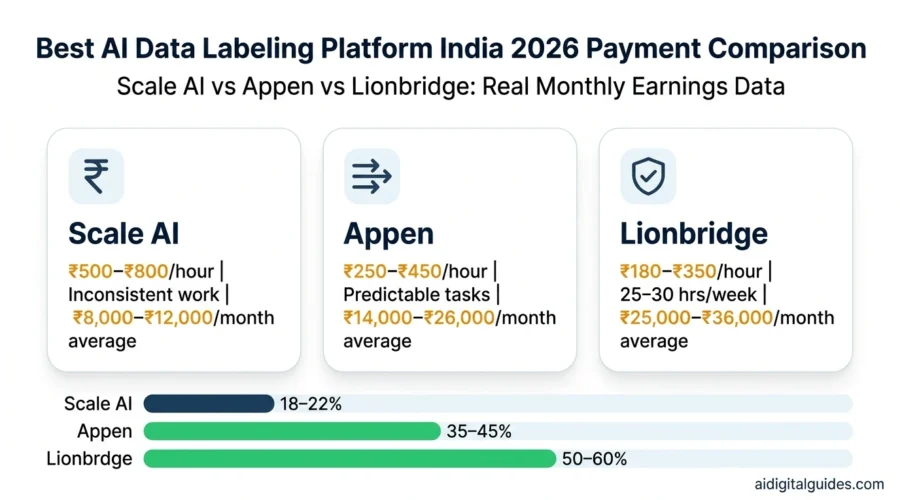
Scale AI dominates Reddit discussions among Indian freelancers for one reason: payment rates. Tasks on Scale AI typically range from ₹400–₹800 per hour, with some specialized projects paying ₹1,000+ per hour. That’s significantly higher than competitors.
However—and this is critical—work availability is wildly unpredictable. You might land ₹15,000 worth of tasks on Monday, then nothing for 10 days. This volatility makes budgeting difficult.
Real earnings scenario: A freelancer in Bangalore reported earning ₹8,000–₹12,000 per month with Scale AI, working 3–5 hours weekly when tasks were available. Compare that to potential monthly income: if you could get consistent 20 hours per week at ₹600/hour, you’d earn ₹48,000 monthly. But that consistency rarely happens.
Key challenges with Scale AI:
- Approval process is strict; rejection rates are 15–25% for first submissions
- Task variety limited to annotation, labeling, and data validation
- Minimum payment threshold is ₹500 (you must earn this before withdrawal)
- Geographic restrictions apply; not all Indian states qualify equally
Appen: Steady Work, Moderate Earnings
Appen positions itself as the reliable middle ground. Average payment rates hover between ₹250–₹450 per hour in India, depending on project difficulty. While lower than Scale AI, the consistency is notably better.
Appen freelancers report working 10–15 hours per week on average with fairly predictable task flows. This means you can actually plan your income: roughly ₹3,500–₹6,500 per week, or ₹14,000–₹26,000 per month if you work steady hours.
Why the consistency? Appen has corporate contracts requiring constant data flow. They can’t afford work droughts like Scale AI experiences during client downtime.
What Appen lacks:
- Lower hourly rates mean less take-home per hour of effort
- Task quality varies; some projects are repetitive and mentally draining
- Occasional payment delays (5–10 day variance reported)
- Qualification exams are easier than Scale AI but still competitive
For freelancers who prioritize income stability over maximum earnings, Appen is often the better choice. As noted by Ankur Warikoo in his freelancing discussions on YouTube, consistent income beats irregular high-earning spikes for financial security.
Lionbridge: Reliability Over Raw Income
Lionbridge sits at the lower end of the payment spectrum (₹180–₹350 per hour in India) but offers something both Scale AI and Appen struggle to provide: long-term stability and benefits.
Lionbridge treats contractors more like semi-permanent employees. Work is assigned in regular batches, and many freelancers report 25–30 hours of available work per week. With rates at ₹250–₹300/hour (typical), that’s ₹6,250–₹9,000 per week or ₹25,000–₹36,000 monthly.
Why choose Lionbridge despite lower rates?
- Work availability is predictable; you can plan your schedule months ahead
- Employer treats you professionally; less sudden project cancellations
- Variety of projects: document review, content categorization, search engine evaluation
- Performance bonuses available (up to 10% extra for high-quality submissions)
- Support is responsive to contractor issues
The downside? You won’t get rich quick. But if your goal is replacing a part-time job with steady freelance income of ₹25,000–₹35,000 per month, Lionbridge delivers that reliably.
Qualification Requirements and Approval Rates
Your path to income depends first on getting approved. Here’s the brutal reality for each platform:
Scale AI Approval Process: Most stringent. Requires fluent English (video interview conducted), native-level communication skills, and a 4-year degree preferred. Approval rate among Indian applicants: approximately 18–22%. Even after approval, your first 3 submissions are heavily reviewed. One bad rating can trigger account review.
Appen Approval Process: Moderate difficulty. Assessment test covers English comprehension, task instructions, and attention to detail. You get 3 attempts to pass within 30 days. Approval rate: 35–45% for Indian applicants. Once approved, you can apply for individual projects; not all are available to you, but many are.
Lionbridge Approval Process: Easiest. Straightforward English test, short writing sample, and background verification. Approval rate: 50–60% for Indian applicants. After approval, you’re placed into project categories based on performance. More projects become available over time as you build a track record.
Pro tip: Apply to all three simultaneously. Many successful Indian freelancers maintain accounts on multiple platforms to diversify income and work around availability gaps.
Payment Methods and Withdrawal in India
Earning money is one thing; getting it into your Indian bank account is another. Payment logistics vary significantly:
Scale AI: Pays via Wise (formerly TransferWise) or direct bank transfer. Withdrawal to India typically takes 2–4 business days. Minimum payout: ₹500. Fee: negligible for Wise transfers (approximately ₹50–₹100 per transfer depending on amount).
Appen: Multiple options: Wise, PayPal, or direct bank transfer. Slower than Scale AI; expect 5–7 business days. Minimum payout: ₹1,000. Fee: ₹100–₹150 per withdrawal on average.
Lionbridge: Offers both Wise and direct bank transfer. Fastest processing: 3–5 business days typically. Minimum payout: ₹500. Fee: similar to Scale AI, around ₹50–₹100.
Important: All three platforms issue 1099 or equivalent tax documentation. If earning ₹1,00,000+ annually, you’re liable to file ITR (Income Tax Return) in India. Consider consulting a CA (Chartered Accountant) familiar with freelance income taxation.
Which Platform Should You Choose?
Here’s the decision matrix. Choose based on your priority:
Choose Scale AI if: You can afford irregular income. You’re supplementing a full-time job. You have excellent English and can pass a tough approval interview. You want maximum hourly earnings. You’re willing to spend 5–10 hours per week on available work.
Choose Appen if: You want a balance between pay and stability. You aim for ₹15,000–₹25,000 monthly from freelancing. You prefer predictable weekly work without project droughts. You’re moderately confident in English communication.
Choose Lionbridge if: You prioritize work consistency above all. You want to replace part-time job income (₹25,000–₹35,000/month). You value professional treatment and long-term relationship with an employer. You prefer mental variety in tasks over raw hourly rate.
The optimal strategy? Start with Appen (easiest approval, decent income). While waiting for Appen approval, apply to Lionbridge (moderate difficulty). Once established, apply to Scale AI (hardest but highest-paying) as a supplementary income source. This three-platform approach is increasingly common among experienced Indian AI data labeling freelancers.
As explored in our detailed guide on full stack web developer salary vs AI freelancer India 2026 career path, the AI freelancing economy is reshaping income strategies for Indian digital workers. These data labeling platforms are entry points into a broader AI economy where specialized skills command premium rates.
Real Monthly Income Breakdown (2026 Data)
Let’s quantify this. Below is what actual Indian freelancers are earning in 2026:
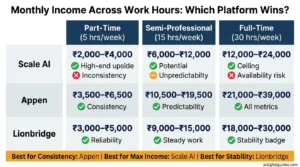
Scenario 1: Part-Time AI Labeler (5 hours/week)
- Scale AI: ₹2,000–₹4,000/month (highly variable)
- Appen: ₹3,500–₹6,500/month (consistent)
- Lionbridge: ₹3,000–₹5,000/month (reliable)
Scenario 2: Semi-Professional (15 hours/week)
- Scale AI: ₹6,000–₹12,000/month (unpredictable)
- Appen: ₹10,500–₹19,500/month (predictable)
- Lionbridge: ₹9,000–₹15,000/month (steady)
Scenario 3: Full-Time Freelancer (30 hours/week)
- Scale AI: ₹12,000–₹24,000/month (requires multiple projects)
- Appen: ₹21,000–₹39,000/month (very achievable)
- Lionbridge: ₹18,000–₹30,000/month (stable income)
Notice the pattern: Scale AI’s income potential grows if you can secure consistent work, but that’s the gamble. Appen and Lionbridge scale more predictably with hours invested.
Final Verdict: The Best Platform for Most Indians
If forced to recommend one best AI data labeling platform India 2026 for the average freelancer, it’s **Appen**. Here’s why:
- Approval rate is reasonable (35–45%)
- Income is genuinely predictable (±10% variance week-to-week)
- Pay is fair (₹250–₹450/hour is respectable)
- Supports real monthly budgeting
- No harsh rejection penalties
However, build a portfolio across all three. Once established on Appen, apply to Lionbridge for backup income. After 2–3 months of solid performance on both, tackle Scale AI’s rigorous approval process. This diversified approach protects you against platform algorithm changes, project droughts, or account issues.
The AI data labeling industry in India is maturing. These platforms now compete not just on rates but on reliability. Choose based on whether you need maximum income (Scale AI), balanced income (Appen), or income security (Lionbridge). Your financial situation will dictate the best fit.